

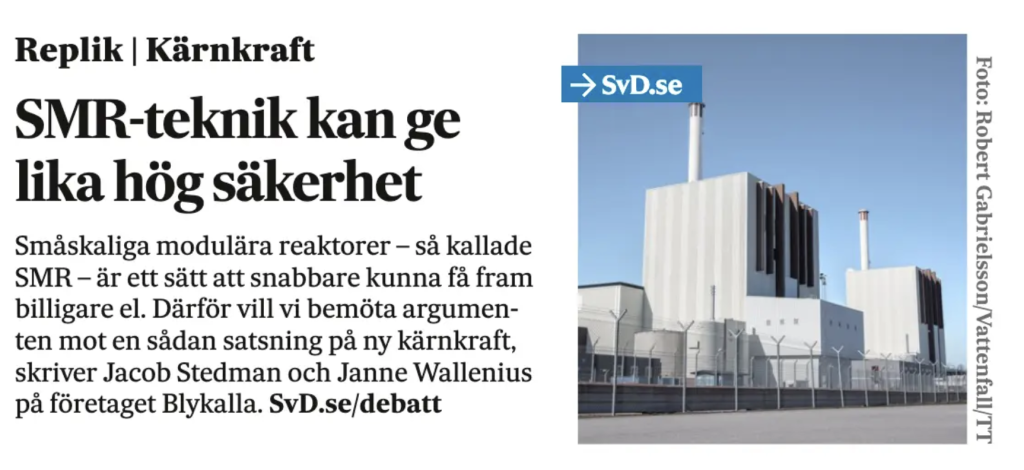
Leadcold CEO Jacob Stedman and co-founder Janne Wallenius published an op-ed today in Svenska Dagbladet. It is available on their web site in Swedish: https://www.svd.se/a/76RbX3/smr-teknik-kan-ge-lika-hog-sakerhet-skriver-stedman-och-wallenius
For convenience, we are republishing it here in English (auto translated).
Bo Cederwall writes on SvD Debatt 18/2 wisely about the advantages of building more nuclear power, but believes that the conditions for distributed electricity production need to be investigated further. We agree with Cederwall on the importance of building new nuclear power to compensate for the power loss that occurred due to the premature shutdown of several Swedish reactors, and to complement the important roll-out of renewable electricity. But Cederwall also puts forward three arguments that we feel compelled to address.
Firstly, Cederwall seems to think that society has not taken the “ethical” discussion about the fact that used nuclear fuel can burden future generations. The claim appears strange: few energy policy issues have been discussed so much in recent decades. All types of production have advantages and disadvantages, so does nuclear power. But in recent years, more and more people seem to have landed in the fact that nuclear power’s advantages more than justify its costs and challenges.
The second argument Cederwall puts forward is that new conventional nuclear power has a higher level of safety than today’s existing reactors. That’s right: all modern reactor systems being developed now can remove residual heat with passive safety systems, even if the power supply is completely cut off. But SMR technology, and especially lead-cooled reactors, can accomplish this at a lower cost. In addition, the safety zones are significantly smaller for small reactors. As Cederwall is aware, SMR also addresses nuclear power’s major challenge: that gigantic construction projects usually take longer and cost more than estimated. By moving from customized giga-projects to standardized industrial production, you get a learning curve that produces progressively lower costs, in the same way as happened for solar and wind in the last decade.
Finally, Cederwall discusses Sweden’s uniquely restrictive legislation that limits the number of locations where nuclear power can be operated, and worries that the consequences of changing it have not been investigated. But that is exactly what the Radiation Safety Authority has been asked to do! And in addition, each individual reactor to be deployed must still be licensed, managed by an operator who will have to take full responsibility for safe and reliable operation, and undergo ongoing nuclear inspections by the International Atomic Energy Agency (IAEA), Euratom and the [Swedish] Radiation and Nuclear Safety Authority.
We agree with Cederwall that it is natural to build Sweden’s first SMR with existing license holders for nuclear facilities. Both competence, permission and transmission speak for it. But we are convinced that the industries and electricity companies that want to build elsewhere, for example to bring down the electricity price in price range SE3 and SE4 or to meet the needs of the energy-intensive industry, will take the choice of location and local security very seriously. Their applications will also be scrutinized with the utmost care by the government and the Radiation Safety Authority. We are also convinced that the ongoing nuclear control will work as well as it does in all other countries where there are no geographical restrictions on building nuclear power.
In conclusion, we welcome the government modernizing legislation and enabling nuclear power to help solve both the climate crisis and the energy crisis at the same time. It is important to remove the limitation on the number of units, to enable more but smaller reactors. And energy companies, the government, municipalities and the Radiation and Nuclear Safety Authority will all be involved in the decision on where new nuclear power will be operated. Just like in all other countries, you can get by without legislation codifying the exact coordinates.
Jacob Stedman, CEO Leadcold
Janne Wallenius, co-founder and CTO Leadcold and professor of reactor physics at the Royal Institute of Technology (KTH)